A Future in Sync
"These days, it's hard to feel like we're on the same page: with each other, with the world around us, even with ourselves. In response, it feels like we're seeking the solid ground of synchrony: reaching out to the collective, reaching back to our roots, and reconsidering our relationship with space and time to find our footing yet again."
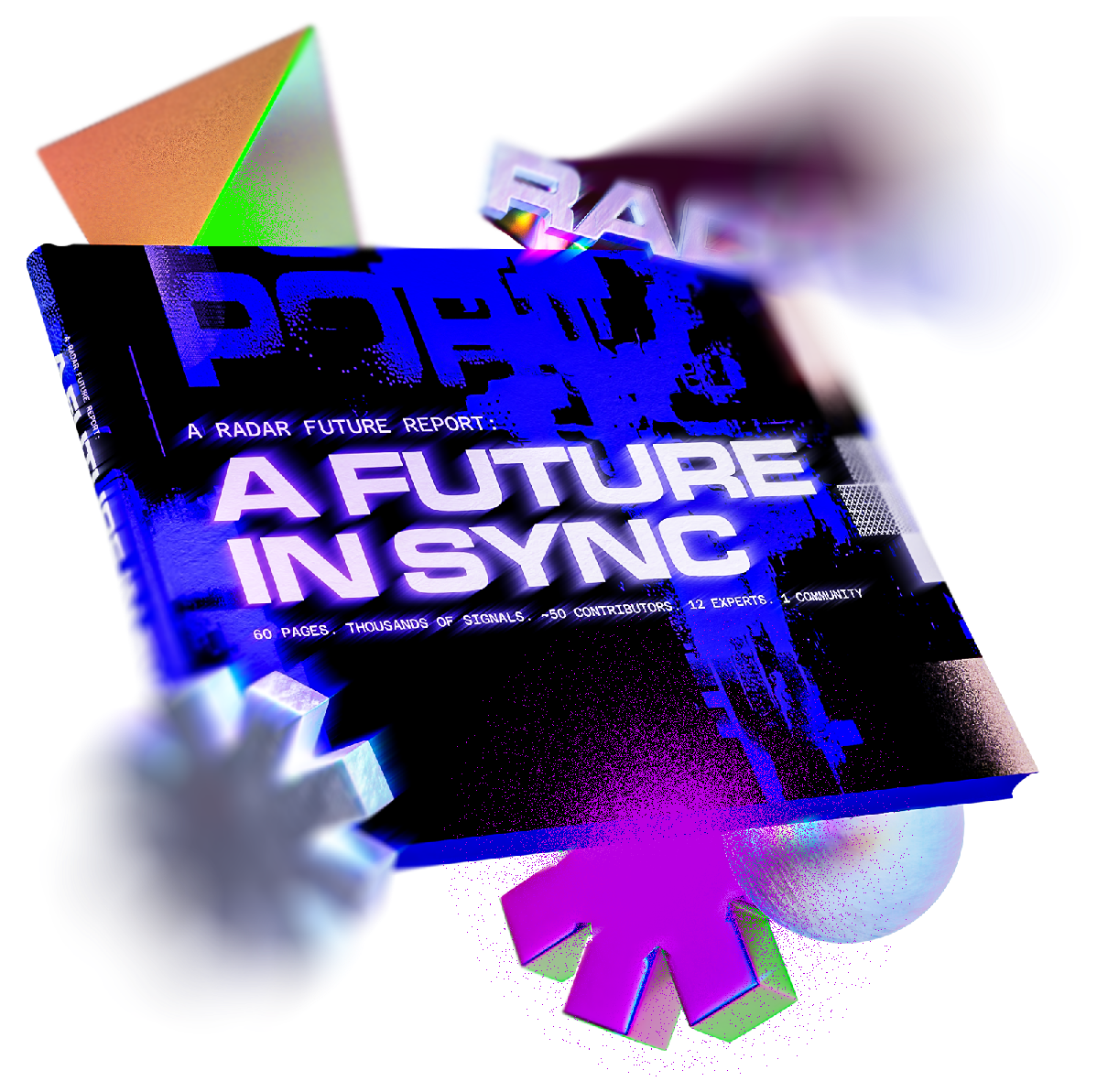
A Future in Sync was RADAR's inaugural cycle, exploring how we might find new rhythms of connection in an increasingly disconnected world. It featured our first experiments with decentralized research and collective imagination.
While the site itself is no longer live, you can find all of the contents of our exploration archived here.
Front Matter
60 PAGES. THOUSANDS OF SIGNALS. ~50 CONTRIBUTORS. 12 EXPERTS. 1 COMMUNITY. A FUTURE IN SYNC.
Front Matter
60 PAGES. THOUSANDS OF SIGNALS. ~50 CONTRIBUTORS. 12 EXPERTS. 1 COMMUNITY. A FUTURE IN SYNC.
Who We Are
Many futurists, foresight practitioners, and strategists agree with William Gibson that “the future is already here, it’s just not evenly distributed.” Often framed as commentary on the inequity of knowledge and innovation, this view is rarely embraced as a lens for reflection within the futures industry itself; but it should be.
Important futures work is often gated, in walled gardens — or worse — collecting dust on clients’ shelves: detached from its creators, and disconnected from the context and trajectory of the world around it.
How We've Done It
Signal Scanning
Signal scanning is the always-on engine that fuels our entire research process. From #ai-algorithms and #media-brands to #aesthetics, #environment and #education, our channels explore broad cultural pillars and specific trends alike. Signal scanning serves as an evolving platform for collective curation, sense-making, and discussion of what’s next; and it all happens at RADAR HQ on Discord.
Letter from the Lead
If we’re being honest, we weren’t sure how this report would play out. In true web3 fashion, we’re building the plane as we fly it.
With ~170 members, about 50 active daily, and over half of those committed to support a five-member project team in both independent and multiplayer research, this was going to be a true community experiment.
How We Got Here
We know, you know, NASA knows, Timothée Chalamet knows: The vibes are decidedly off. We’ve lost our footing. We can’t find our rhythm. And it’s disorienting.
Our relationships with each other, ourselves, and the world around us have undergone monumental change at an unsustainable pace, hindering our ability to cope. “Everything, everywhere, all at once” is right.
How We Got Here
We know, you know, NASA knows, Timothée Chalamet knows: The vibes are decidedly off. We’ve lost our footing. We can’t find our rhythm. And it’s disorienting.
Our relationships with each other, ourselves, and the world around us have undergone monumental change at an unsustainable pace, hindering our ability to cope. “Everything, everywhere, all at once” is right.
It’s not just bad vibes or Mercury in retrograde: The drivers that have caused this shift are numerous and tangible, from loss and impermanence to misalignment and atomization. As they converged, they ushered in a system overload that’s not unlike an aging Macbook with 74 open tabs.
While they have their unique origins and implications, each driver contributes to clogging the mechanics of our three identified spheres of synchrony, creating a paper jam without a qualified technician in our midst.
Loss
TL;DR
Let’s face it: We’ve lost a lot. Somewhere between the advent of the clock that would produce modern time and one that would dare to remind us of our collective deadline, we lost all sorts of things. Common touchstones and cultural pacemakers; fidelity in our interactions; connection with the world around us; and our individual and collective roots. Throw in any remaining sense of control for good measure. When you reflect on it, we’ve seen all of it slip away at an intensifying pace, without much notice of the ‘when’ or ‘how’ of it all.
Misalignment
TL;DR
There are a lot of ways to talk about synchrony: On the same page, on the same wavelength; in lockstep, in sync. No matter the metaphor, they all center around a general sense of alignment. So when looking at what’s driven us out of sync, we shouldn’t be surprised to see misalignment as a significant factor. Expectations are out of step with reality; incentives are out of step with behaviors; and our existing mechanisms and systems are simply no match for the moment at hand. With contradictions abounding, cracks in cohesion with ourselves, each other, and the world around us are widening.
Impermanence
TL;DR
Culture has never felt more ephemeral: It feels like we’ve lost our ability to cultivate longevity when it comes to just about anything. Our relationships with things have become increasingly disposable, at the larger expense of any remaining heirloom mentality. Our relationships with people have frayed, too, with friendship and community dynamics shifting towards fewer and fewer ties at varying strengths. We’ve realized the fragility of places and spaces, both constructed and natural — from losing local businesses and gentrifying local culture to witnessing landscapes fade and change with time. When everything feels fleeting, can we really be blamed for feeling untethered?
Atomization
TL;DR
You know that parable about the blind men and the elephant? Where everyone’s perception was different because each was limited to their isolated perspective? That’s not far off from how you might describe our current collective relationship to the world: Society is splintered into fragments, atomizing our experiences down to the bespoke individual. Culture’s chasms have grown — both in how many there are and how big they’ve gotten. Our relationships with information, sources of truth, and even reality itself have fractured into factions. And the widening distribution of people, place, and purpose has destabilized already precarious systems to an alarming degree.
System Overload
“The world went and got itself in a big damn hurry.” It’s what prison librarian Brooks quips, with equal parts marvel and disdain, upon his release after 45 years in Shawshank. It’s also a pretty appropriate capture for what’s got us here today. Our world is becoming harder to comprehend, tougher to keep pace with, and exhausting to make sense of — as everything accelerates seemingly all at once, at far greater speeds than our bodies and brains are meant to keep up with. But truly: Biology (attuned to nature) evolves precisely but slowly over the course of millennia; culture (attuned to socio-economics) evolves so quickly we quite literally cannot keep up.
And it’s only set to get worse; according to Ray Kurzweil’s Law of Accelerating Returns, the math looks something like this: In 2040, we’ll experience an entire year of change (based on today’s rate) in about 3 months. For those who are 10 today, by the age of 60, they’ll experience 2022’s change in just about 11 days. And none of this even factors in the accelerating disruption of climate change.
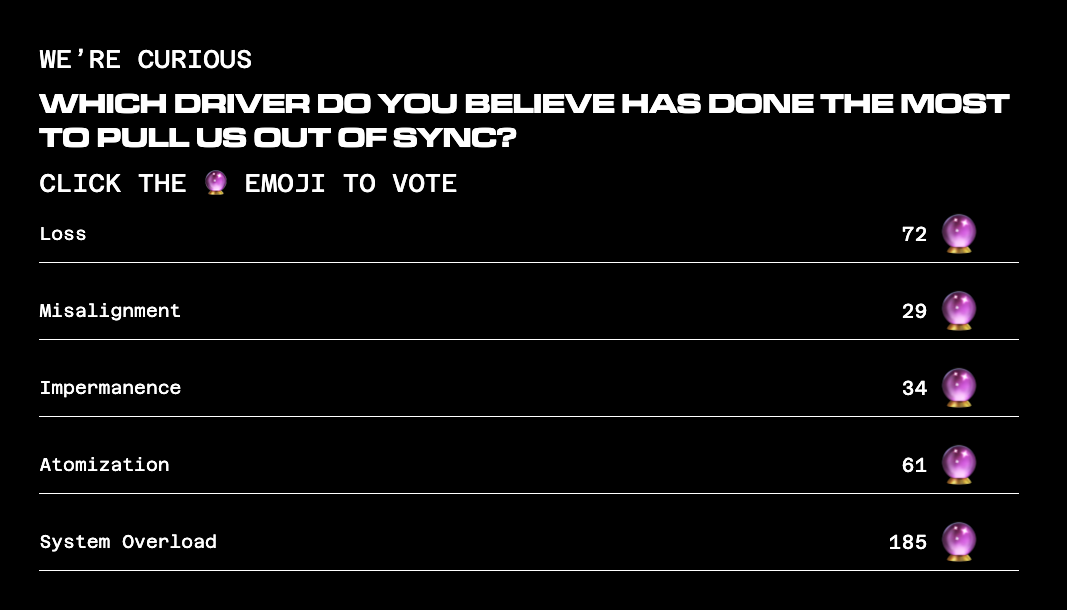
Woof
From VUCA → BANI
Let’s summarize what we’ve covered so far: Loss; impermanence; misalignment; atomization; system overload. Each is accelerating out of hand in its own special way. Resilience is in the gutters, metrics of fragility are worsening, long-enduring staples of stability are finding themselves on shakier ground: Our brains are in constant fight-or-flight mode.
Woof
From VUCA → BANI
Let’s summarize what we’ve covered so far: Loss; impermanence; misalignment; atomization; system overload. Each is accelerating out of hand in its own special way. Resilience is in the gutters, metrics of fragility are worsening, long-enduring staples of stability are finding themselves on shakier ground: Our brains are in constant fight-or-flight mode.
Did you know there's academic framework for that?
First, Let's Talk VUCA
[The realities we've discussed so far] are manifestations of a VUCA world — the predominant archetype describing our current paradigm, an acronym standing for Volatility (unstable, fragile, and often without threshold clarity); Uncertainty (unpredictable, random, and often without a decipherable pattern or adequate information); Complexity (unstructured, interdependent, and often without a clear start and end point); and Ambiguity (unclear, paradoxical, and often without a solution even despite adequate information).
Dating back to 1987 and attributed to the US Army College, VUCA was originally articulated as a navigational framework for the post-Cold War era. Since then, it has trickled down into political and military strategies, business studies, and management and leadership ecosystems. Today, all signs point to VUCA’s acceleration and intensification as its impacts become more pronounced in everyday societal dynamics — particularly since the pandemic. While 9/11 is considered an important catalyst, Niall Ferguson’s book The War of the World asserts that the roots of our VUCA paradigm can be traced further into 20th century violence, rippling outward into the disconcerting challenges we face today.
Enter BANI
There hung a chill in the air, though warmer than it used to be. She welcomes it; slowly, but eagerly, emerging from her home, bidding adieu to the long winter that lay behind, and welcoming the onset of summer. The snow was melting, but a little differently. The color, the texture, the strength: there was concerning variance. “This can wait,” she thought as she headed further out for a meal — stopping dead in her tracks. The snow ahead lay cracked and fractured — a blue-green waterworld was all that remained, stretching into the horizon with no end in sight.
If the polar bear’s experience — and its anxiety, anguish, and alienation — felt relatable, it’s because there are acute parallels to draw here. For now they’re metaphorical.
WTF, Seems Bad (An Aside)
Can we pause for a moment and consider what just happened there? We VUCAd so hard we quite literally broke the acronym. We needed to hunt down a collection of worse words to articulate all of *gestures broadly* this.
If that sounds pretty bad, it frankly feels — maybe worse?
How It Feels Now
If this report hasn’t hit you in the feels already, it will now. Because this bit is visceral — at least, it was for us. We’re seeing post-narrative discomfort converging on fatigue, driving a feeling we can only describe as paralysis; it’s no wonder we’re hunkering down and slipping into nihilism. All of this is — almost painfully — relatable.
As you hear it from the voices of community members and respondents from around the globe, see it brought to life in absurdist memes and morbid TikToks, and confront the realities of life in this moment you just get it. You get that things ~aren’t great~.
How It Feels Now
If this report hasn’t hit you in the feels already, it will now. Because this bit is visceral — at least, it was for us. We’re seeing post-narrative discomfort converging on fatigue, driving a feeling we can only describe as paralysis; it’s no wonder we’re hunkering down and slipping into nihilism. All of this is — almost painfully — relatable.
As you hear it from the voices of community members and respondents from around the globe, see it brought to life in absurdist memes and morbid TikToks, and confront the realities of life in this moment you just get it. You get that things ~aren’t great~.
In Our Feels
“I think the biggest challenge of our time, that undermines our collective efforts to create more equitable futures, is our decreasing ability to think and imagine long-term, beyond ourselves. I think the stories we tell ourselves, or have been told inaccurately about our pasts — our lands, histories, and people — are haunting our present and our abilities to think about our futures.” – Tamika Abaka-Wood (Expert Interview)
Suffice it to say, it's a lot to unpack
Post-Narrative Discomfort
Humans are a storytelling species. It’s who we are. It’s what gives us our foundation and where we find common ground. Epic tales and archetypes — for better and for worse — are with us for a reason. So the idea of existing in a post-narrative world isn’t just foreign, it’s unprecedented. The transition from a realm of grand unifying stories to one where many narratives co-exist — both globally and within ourselves — is a worthy one; but for now we find ourselves on the threshold in between, stuck in a sort of purgatory that leaves us lost without the comfort of a shared context.
“Stories are compasses and architecture; we navigate by them, we build our sanctuaries and our prisons out of them, and to be without a story is to be lost in the vastness of a world that spreads in all directions.” – Rebecca Solnit, The Faraway Nearby
Fatigue
Living in the current state of things is starting to feel exhausting. Layer in constant news consumption and self-reflection on top, and it reaches a whole new level. It’s no wonder that ideas of radical rest have entered the discourse: It seems the toll of this multi-layered fatigue is one that can only be resolved through revolutionary action.
♪〰〰〰〰〰〰🎧〰〰〰〰〰〰♪
Paralysis
You know how, sometimes, when a machine overheats, it simply shuts down? That’s a pretty good analogy for what we're seeing. Overwhelmed by unanswerable questions of what to do, who to trust, where to turn, and whether any of it even matters, many of us are opting out. Choosing to assume that someone else might step in, or more drastically, concluding that there’s nothing to be done in the first place. Today, the distance between wanting to try, trying, and actually doing feels massive — and the forces of the world aren’t doing much to help us close those gaps.
Hunkering Down
To hunker down is to settle into a safe, sheltered position until an enemy retreats, or the storm passes. Relatable, right? There’s a real privilege in the ability to seek comfort in the midst of a raging storm, sinking into the coziness of the familiar and holding on tight. And it’s not surprising that those of us with that privilege are taking advantage.
Nihilism
In what may be our most revisited common thread in the RADAR community, there’s little denying that nihilism has permeated whatever zeitgeist remains. From quiet withdrawal and existential dread to wild rebellion and the embrace of the dirtbag, we’re seeing it manifest in a host of different ways — so many, in fact, that it often feels like a big, dark cloud hanging over many of the trends we’ve watched emerge in recent months.
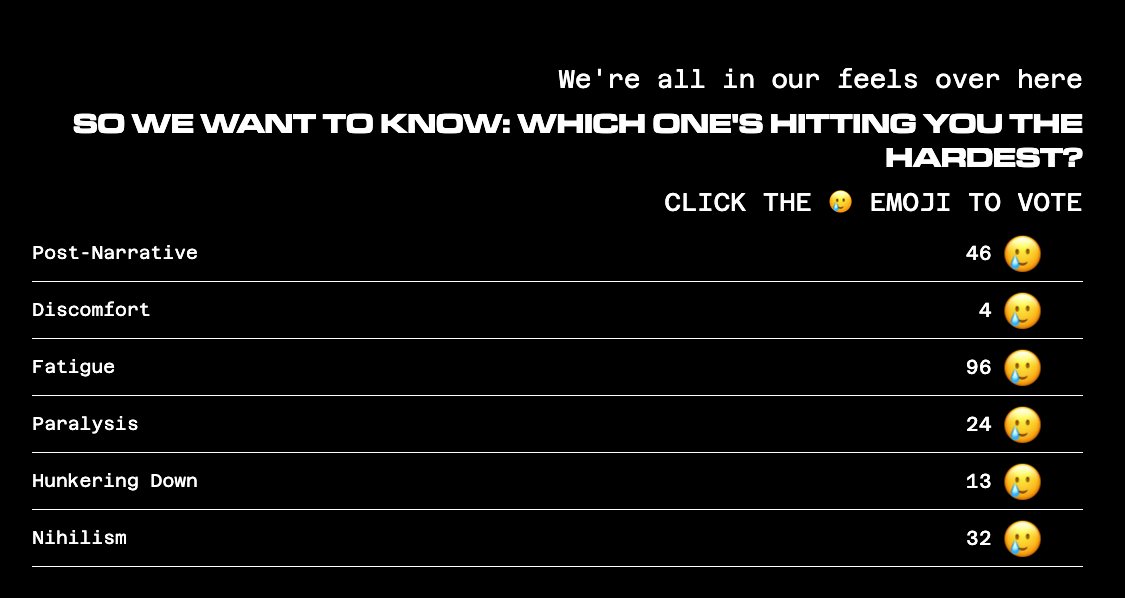
How We Find Our Way Out
In the wise words of Red Redding: “Every man has a breaking point.” And as we swirl around in this particular vortex, it seems we’ve collectively reached ours.
But it’s not just at the individual level; entire fields of thinking are realizing that ‘what was’ won’t hold.
How We Find Our Way Out
In the wise words of Red Redding: “Every man has a breaking point.” And as we swirl around in this particular vortex, it seems we’ve collectively reached ours.
But it’s not just at the individual level; entire fields of thinking are realizing that ‘what was’ won’t hold.
A Moment of Realization
We’d grown comfortable with thinking about our lives in mechanistic, systematic ways. Problem, solution, problem, solution. But the thing is: We don’t live in a machine; our world doesn’t operate systematically, as much as we might like it to. And finally, that’s become abundantly clear.
The world around us has become so complex and chaotic that we aren’t equipped with the adequate concepts to explain it. The toolkit we’ve been toting around for decades is suddenly useless for addressing our new reality.
The Multiverse Answer?
The Marvel Cinematic Universe’s Loki series revolves around time travel and variants. But at its center are ideas of the multiverse and ‘nexus events’ (i.e., #the-futures-we-dont-want🕳), which cascade into unstoppable ripple effects of multiplying, accelerating, branching realities. Sound familiar? 🫠
It’s interesting how the series focuses on themes of control and destiny, ‘allowing’ for only a particular set of events compatible with order to occur, lest chaos ensue. This focus on control, of course, turns out to be for naught, as the season (SPOILER ALERT) concludes with a Pandora’s box of non-linear chaos systems breaking open a full-on multiverse of madness.
We love a good portal to a new universe as much as the next decentralized community — and the multiverse is certainly one answer to this mess — but we've got a few more tangible suggestions.
Finding Our Way
New Structures, New Stories, and New Behaviors are the keys to unlocking a Future in Sync. But new doesn’t always mean novel: In certain pockets, the ancient meets the emergent to light our path forward; in others, it’s about rethinking and reconstructing to reset our pace; and elsewhere, it’s about stepping outside of time entirely and allowing ourselves get swept away in playful whimsy, awe, and catharsis into a more wild, emotionally-rooted form of synchrony.
If it sounds overwhelming, we might find some comfort in the incredible generative potential of this transitional space we’re trying to leave. As Anne-Laure Le Cunff recently wrote, “Liminal creativity is new ideas emerging from the unknown, identities changing through challenges, innovations sprouting in the midst of chaos, new beginnings built from the remains of failures.” It’s an attitude of openness and vulnerability that acknowledges the need for kindness, creativity, and a bit of magic to make it all work.
Conclusion
What started as one Signal (it was about a hospital building trying to figure out how to help its patients feel more in sync) amounted to all of this. And for so many in the community, the process was deeply cathartic. Because this was an exploration that truly touched us all. That captured the moment we’re living through as a global collective and reflected on what got us here to begin with.
The loss, misalignment, impermanence, atomization, and system overload have been bubbling up for some time. The moody mix of post-narrative discomfort, fatigue, and paralysis has led us to hunkering down and falling into the cold embrace of nihilism. And the realization that there simply has to be something different: a new way out; a break from the faulty frameworks of old.
Conclusion
What started as one Signal (it was about a hospital building trying to figure out how to help its patients feel more in sync) amounted to all of this. And for so many in the community, the process was deeply cathartic. Because this was an exploration that truly touched us all. That captured the moment we’re living through as a global collective and reflected on what got us here to begin with.
The loss, misalignment, impermanence, atomization, and system overload have been bubbling up for some time. The moody mix of post-narrative discomfort, fatigue, and paralysis has led us to hunkering down and falling into the cold embrace of nihilism. And the realization that there simply has to be something different: a new way out; a break from the faulty frameworks of old.
All of that hit us hard.
So many of us are currently in the position of building what’s next. Whether we’re supporting brands on their paths forward, cultivating communities that aim to break the mold, or striking out on our own, the yearning to create a better, more in-sync future runs deep.
We hope that the New Structures, New Stories, and New Behaviors uncovered here can serve as a roadmap for doing just that.
If we can imagine new frameworks, cultivate new systems of belief, and build new structures of belonging; If we can help the world reprioritize its values, find better common language, and facilitate new pacemakers and points of shared connection;
If we can build toward a world that embraces new modes of healing; that experiences more moments of collective effervescence, and approaches life with more playfulness, whimsy, and a hint of mischief… That might just do it.
But at RADAR we don’t stop at ‘Maybe.’
As we said from the outset, building ‘The Future of Futures’ means actively manifesting the futures we explore together. So this isn’t the end; it’s really just the start.
FutureMapping
Most reports stop before they ever get started (in our humble opinion), failing to extend their thinking into imagined futures that drive meaningful implications for what’s to come. So for us, this is where things get really interesting.
Our Future Mapping process was built on a philosophy of 3 Ps: balancing push with pull so that we could ultimately plot a path of action into the future that would set the course for our incubation and delivery stages.
FutureMapping
Most reports stop before they ever get started (in our humble opinion), failing to extend their thinking into imagined futures that drive meaningful implications for what’s to come. So for us, this is where things get really interesting.
Our Future Mapping process was built on a philosophy of 3 Ps: balancing push with pull so that we could ultimately plot a path of action into the future that would set the course for our incubation and delivery stages.
This meant starting with a work-session where we gathered the project team, research squad, and other relevant community members to explore the push and pull of the future based on the new structures, new stories, and new behaviors we’ve just explored.
With a 10-year outlook, we used worldbuilding techniques to unpack what felt possible and probable (the push) and what was preferable based on all things RADAR (the pull). There were even moodboards — and they were glorious.
We explored questions like: What kind of world will the tailwinds of these trends push us toward? What cultural ideas will emerge? What societal structures will be reconsidered? What technologies, mediums, arts, and sciences will be used to connect people, places and things? What goods and services will we make and how will we consume them?
And just as importantly: What kind of future do we want this to drive toward? Given RADAR’s values and beliefs about what makes for better, more inclusive futures, what ambitions, desires, and visions of the future do these trends inspire? What do we want to pursue that can be both aspirational and achievable given RADAR’s incubation process?
Where these ideas intersect would become our center of gravity: the clearly defined future from which we’d reverse engineer a path of action.
While we worked as a small team in the initial session to ideate what that might look like, this was a pivotal moment where we knew we wanted to engage the whole RADAR community. And so, from our push and pull conversation, we curated three visions of the future — potential centers of gravity for the community to vote on. And by the will of the community, we emerged with just one to guide us in our final futuremapping session.
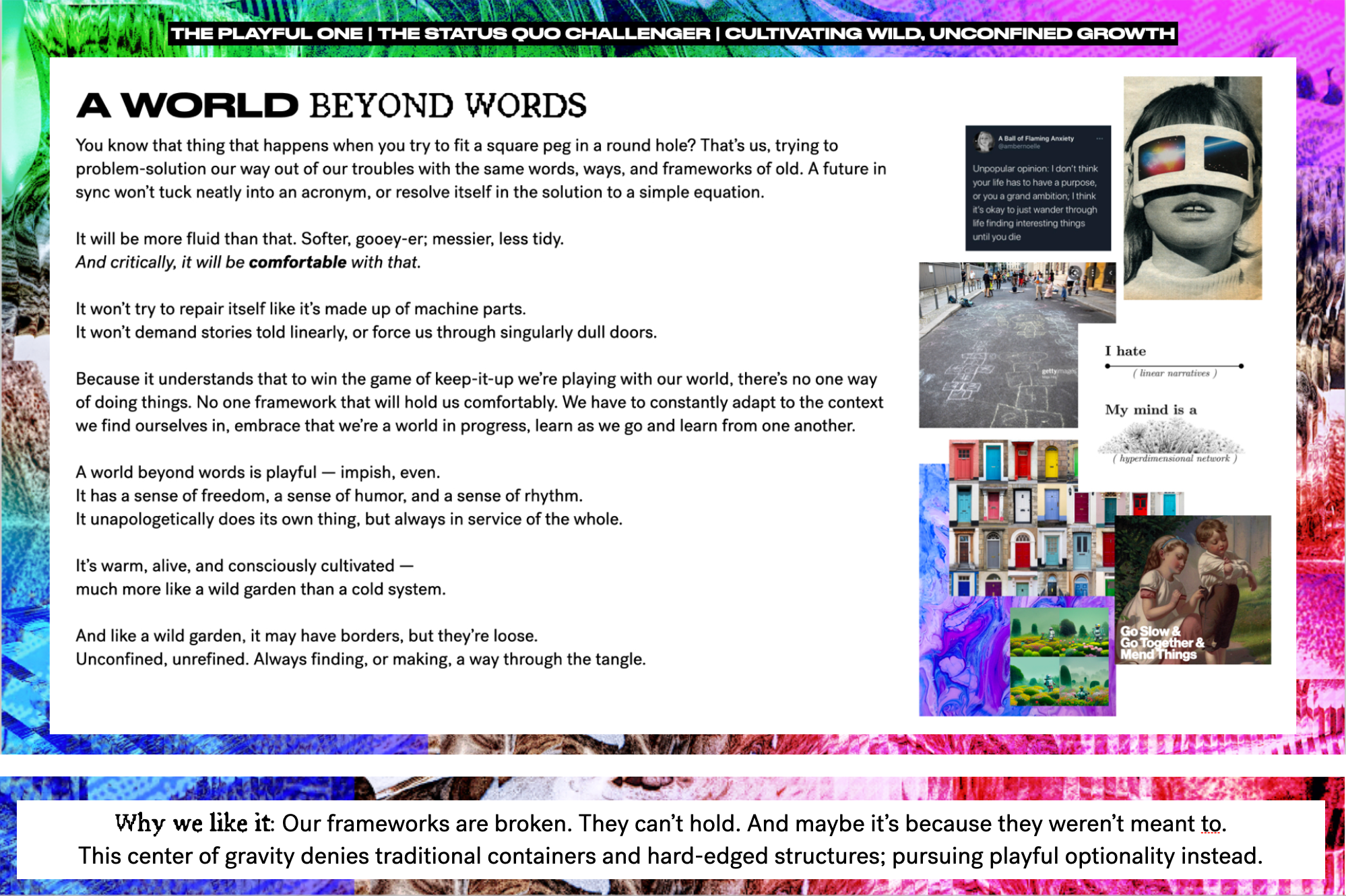
So we set about backcasting: plotting the potential path of action required to manifest our World Beyond Words. In this final session we gathered the original crew that engaged in push and pull, while also bringing in members of the incubate squad to help us think through the kinds of possibilities, products, partnerships, and platforms that could serve as stepping stones to our desired future. These could be just about anything: cultural artifacts or activations, transformative technologies, new goods and services, coalitions and collabs — you name it.
The outpouring of ideas was incredible: full of visions of the future that can lay the foundations for and — we hope — inspire even more creative brilliance as we work our way toward incubate’s FUTURETHON.
But first, a teaser.
Visions of the Future
If there’s one red thread in A World Beyond Words, it’s comfort with multiplicity. No square pegs in round holes here: We’re done trying to problem-solve within the confines of a cold system.
This garden we’re cultivating is a wild one. Constantly learning, adapting, growing, and evolving. Nurturing narratives that celebrate idiosyncrasy, in service of the larger ecosystem we share.
Gratitude
RADAR Instigator: Fancy
Research Lead: Keely Adler
Gratitude
RADAR Instigator: Fancy
Research Lead: Keely Adler
Incubate Lead: Matt Weatherall
Project Team: Sarah Owen
Project Team: Petah Marian
Project Team: Akash Das
Project Team: Severin Matusek
Project Team: Alice Sweitzer
Editor: Emily Howell
Editor: Alice Greenberg
Designer: Domingo
SuperCurator: Keely Adler
SuperCurator: Sarah Owen
SuperCurator: Andrea Chen
SuperCurator: Olga Shaeva
SuperCurator: Linda Xiao